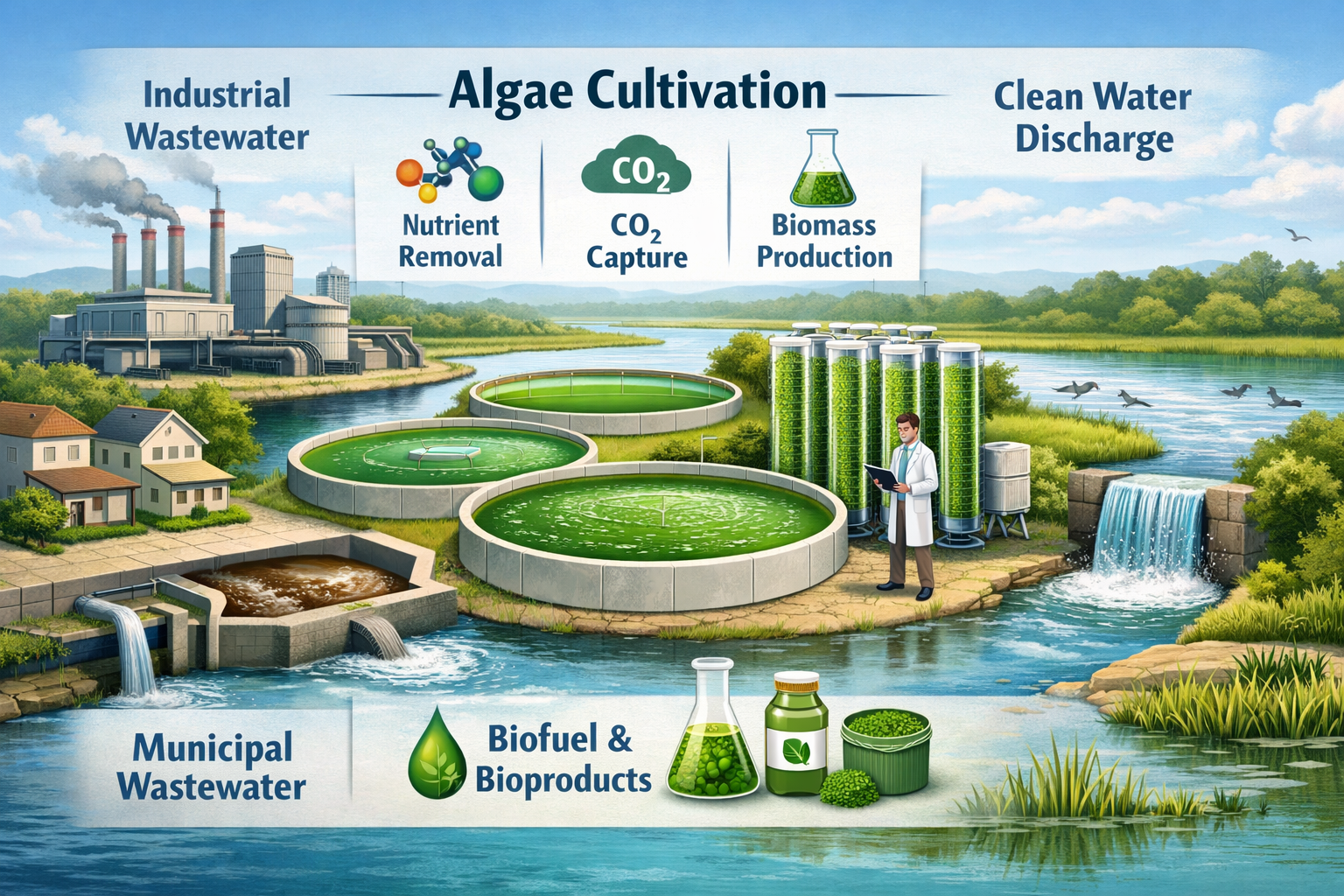

Commercial demand for algae-based wastewater treatment is strongest in Asia-Pacific, the Middle East and North Africa (MENA), North America, and Europe, with Latin America emerging behind them. That ranking is an inference from where wastewater spending, water stress, reuse regulation, and industrial wastewater volumes are most intense. Globally, the wastewater treatment services market is expanding quickly, and Asia-Pacific is repeatedly identified as the fastest-growing region because of industrialization, urbanization, pollution pressure, and reuse needs.
Asia-Pacific has the highest commercial pull overall, especially in China, India, Japan, South Korea, Singapore, and Southeast Asia. The region is rapidly adding wastewater infrastructure, and market sources show APAC dominating packaged wastewater treatment demand while growing at a strong pace. For algae systems, the commercial logic is clear: large industrial wastewater loads, high nutrient pollution, and rising demand for water reuse make biological, low-energy treatment attractive. India and China are especially important because of their scale, while Singapore and South Korea are leading adopters of advanced water-management technologies.
MENA is the most water-stressed region in the world and therefore one of the most promising markets for algae-based treatment. FAO reports that MENA generates about 21.5 billion m³ of nutrient-rich municipal wastewater each year, and notes that water reuse has great potential because wastewater is a growing and perennial resource. The region’s reuse strategies are especially strong in Saudi Arabia, the UAE, Israel, Jordan, Egypt, and Morocco, where treated wastewater is increasingly treated as part of national water supply planning. That makes MENA a prime market for algae systems that combine treatment with nutrient recovery and reuse.
North America is also a major commercial market, led by the United States and Canada, because of its advanced water infrastructure, strong focus on reuse, and demand for smart treatment systems. Fortune Business Insights says North America held 38.2% of the water and wastewater treatment market in 2025, driven by smart water management and membrane filtration adoption. In the U.S., drought, industrial discharge, and reuse policy are pushing interest in alternative biological systems; New Mexico’s recent move to regulate reuse of fracking wastewater shows how recycled-water demand is widening.
Europe remains highly relevant, especially in Germany, France, Spain, Italy, the Netherlands, the UK, and Switzerland. The EU now has a formal water-reuse framework, and the European Commission says 1 billion m³ of treated municipal wastewater is reused each year, with potential to reuse six times that amount. Europe’s demand is driven less by raw growth and more by stricter environmental compliance, circular-economy policy, and micropollutant control. Latin America, led by Brazil, Mexico, Chile, and Colombia, is an emerging market because OECD reports 54% of domestic wastewater flow is untreated, but it is still behind the four regions above in current commercial demand.