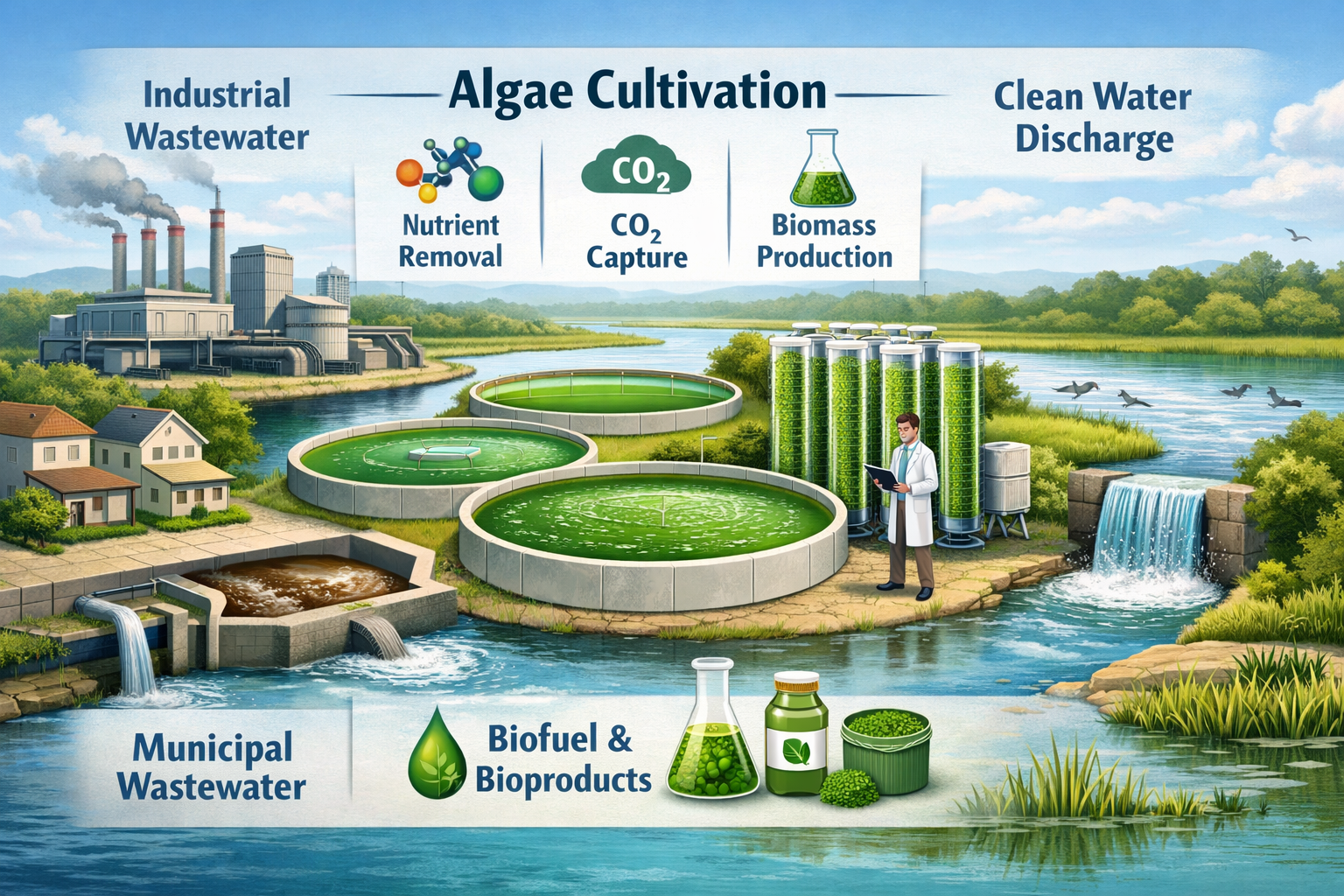
The largest operating cost in algae processing is usually harvesting and dewatering, because algae are grown in very dilute suspensions and must be concentrated before any downstream conversion. Reviews estimate that biomass recovery alone accounts for about 20–30% of total production cost, and in open-pond systems the recovery step can represent the majority of the separation cost when centrifugation, filtration, or flotation is used. That is why harvesting is one of the main commercial bottlenecks worldwide.
Within harvesting, the main cost drivers are electricity, flocculants, pumps, and membrane or centrifuge operation. NREL notes that for some dewatering options, the energy input can approach or even exceed the energy content of the biomass, which is why the choice of process matters so much. In a 2025 techno-economic study, membrane-based dewatering had relatively low power demand at about 0.02–0.4 kWh/m³ feed, while dissolved-air flotation became the most expensive option mainly because of flocculant requirements.
The next major cost center is cell disruption and extraction. Algal cells often have tough walls, so industrial systems may need bead milling, high-pressure homogenization, ultrasonication, pulsed electric fields, chemical pretreatment, or enzymatic hydrolysis. Reviews of downstream processing show that bead milling and high-pressure homogenization are strong options for high-value compounds, but they are energy-intensive and equipment-heavy. Solvent-based extraction also adds cost through solvent purchase, recovery, handling, and safety controls, especially when using organic solvents or supercritical CO₂.
Refining and purification add another major layer of operating expense. After extraction, targeted molecules may need chromatography, membrane separation, depolymerization, or fractionation before they reach food, feed, cosmetic, or chemical grade. The downstream review specifically notes that purification can rely on chromatography and membrane technology, while membrane-based dewatering literature warns that fouling reduces flux and raises both energy and cleaning-chemical consumption. In commercial practice, those cleaning cycles and membrane replacement costs are significant.
Finally, operating costs also rise from drying, water recycling, residue handling, and quality control. NREL’s algae design work uses a multi-step dewatering train to take biomass from about 0.5 g/L to 200 g/L, showing how much water must be removed before conversion. The best way to offset these costs is to run algae as a biorefinery, recovering lipids, carbohydrates, proteins, and coproducts instead of a single product. NREL notes that selective fractionation into multiple product streams is a key route to improving economics globally.