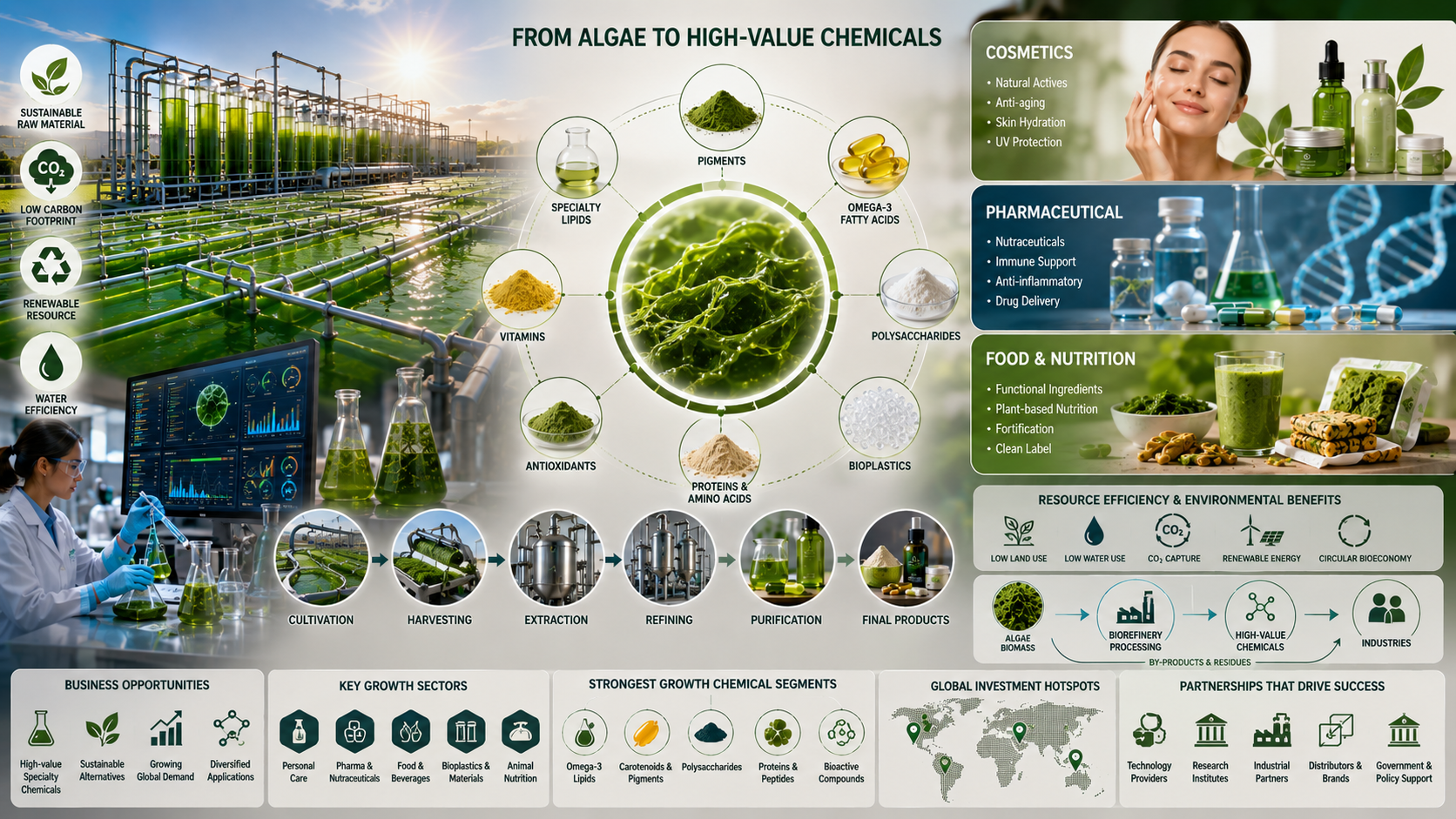
The countries investing most aggressively in algae-based chemical technologies are the United States, China, India, Japan, France, Spain, Germany, Australia, and Saudi Arabia. The global pattern is clear: Asia accounts for about 97% of world algae production, while Europe and the United States are concentrating on higher-value bioproducts, biorefineries, and scale-up infrastructure. That makes the sector a mix of large production bases and high-value innovation hubs rather than a single-country market.
The United States is one of the most active investors because federal agencies continue to fund algae R&D for fuels, chemicals, and low-carbon products. In 2024, the U.S. Department of Energy announced $20.2 million for 10 projects to advance mixed algae for biofuels and bioproducts, and in 2025 it signaled further support through the planned MASY program to improve affordable algae system yield. This shows the U.S. is still treating algae as a strategic platform for bioproducts and industrial decarbonization.
India and Japan are also investing heavily, but with a more biomanufacturing-oriented approach. In India, DBT-BIRAC has active 2025 calls for biomanufacturing, functional foods, carbon capture, and smart proteins, and BIRAC-supported algae firms are already commercializing algal DHA using industrial standards. Japan is building algae capability through NEDO and related national programs; its microalgae platforms focus on CO₂ fixation, high-value ingredients, and integrated biorefineries, including projects to produce useful substances from microalgae.
In Europe, the strongest country-level activity is in France, Spain, and Germany. A 2025 review of the European microalgal sector found 146 microalgae-derived products from 66 producers, with France leading spirulina production, followed by Italy and Spain; it also noted that Spain has the most microalgae companies overall, with Germany close behind. The European Commission’s algae initiative and related funding have made the EU a major commercialization zone for nutraceuticals, cosmetics, and sustainable bioproducts.
Outside the main blocs, Australia and Saudi Arabia stand out as fast-rising investors. Australia continues to back algae biotechnology through research funding and commercial startups, while Saudi Arabia has moved from interest to execution: the DABKSA program is a joint project with the Ministry of Environment, Water and Agriculture, and it targets a 100,000-hectare microalgal biomass development pathway for feed and related applications. In practice, these countries are investing where algae fit national goals for food security, carbon use, and bioeconomy diversification.
Checkout the questions from Chemicals
- Which partnerships are important for scaling algae-based chemical businesses successfully?
- Which business models are most effective for algae-based chemical companies: ingredient supply, contract manufacturing, or branded products?
- Can algae-based chemical businesses become a major part of the global green economy?
- Which sectors generate the highest demand for sustainable algae-based chemicals?
- What are the major business opportunities in the algae-based chemical industry?
- Can algae biomass waste be converted into additional high-value chemical products?
- Can small-scale algae chemical production units compete with large petrochemical companies?
- Can algae-based chemicals be produced profitably at commercial scale?
- What are the biggest challenges in scaling algae-based chemical manufacturing?
- What are the biggest operational and maintenance challenges in algae-based chemical plants?
- How much land, water, energy, and carbon input are required for industrial algae cultivation?
- What are the major operating costs involved in algae harvesting, extraction, refining, and purification?
- What machinery and processing systems are required for large-scale algae chemical production?
- What technologies can improve the efficiency of algae chemical extraction and processing?
- How can algae-based chemicals be positioned as premium sustainable alternatives in the market?
- Which algae species are best suited for high-value chemical extraction?
- Can algae-based chemicals commercially compete with petroleum-based chemicals?
- How can algae-based chemicals be integrated into the cosmetics, pharmaceutical, and food industries?
- Algae-Based Chemicals: Building a Sustainable Bio-Based Chemical Industry