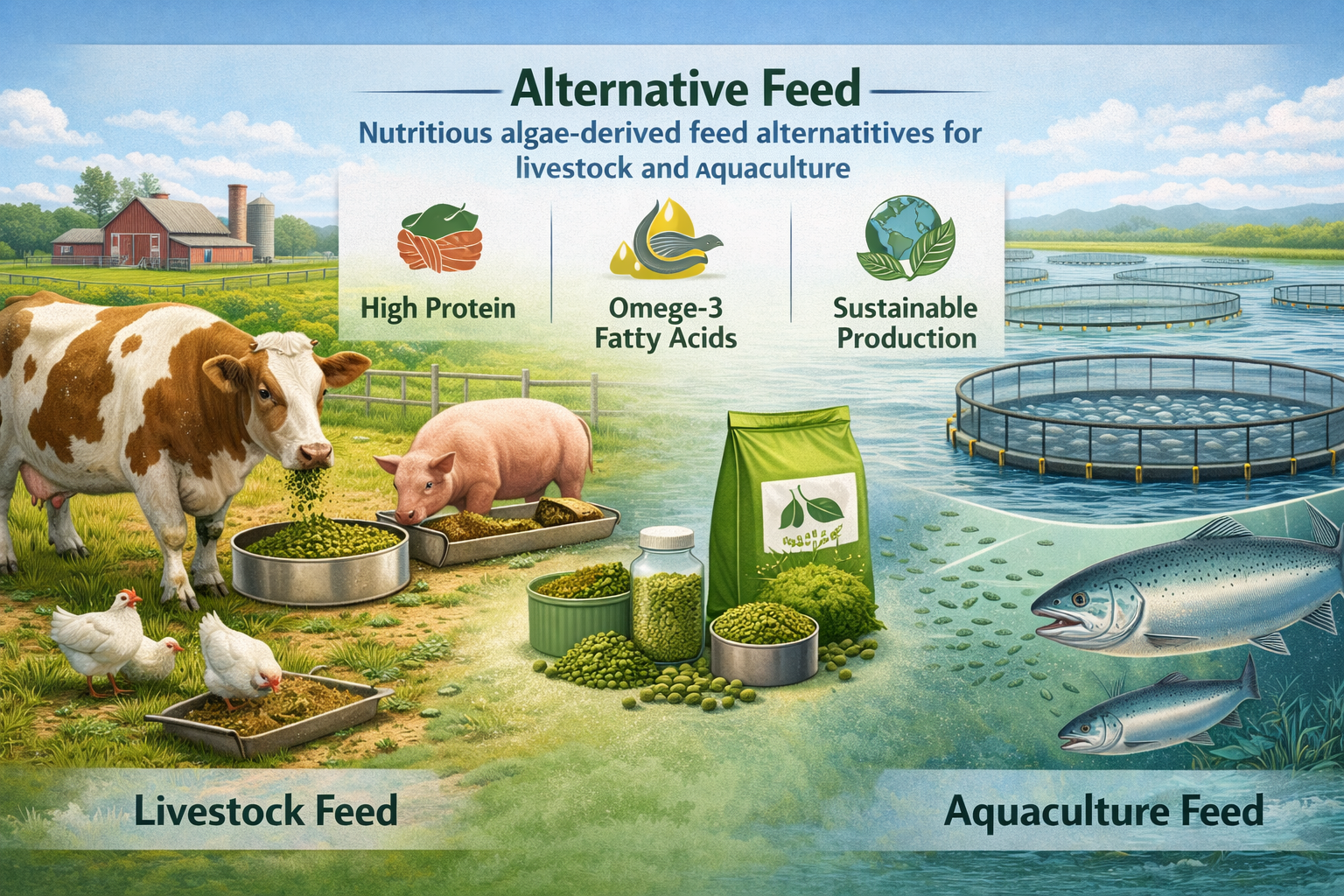
The biggest challenge in commercializing algae-based feed products is cost. Across the literature, the main bottleneck is that algae still remain more expensive than conventional feed inputs such as soybean meal, fishmeal, and corn-based formulations. Reviews of microalgae commercialization consistently note that the industry is still in a nascent scale-up phase, and that cost-effective use is the major barrier to mainstream adoption in poultry, cattle, and aquaculture. In practical terms, this means algae-based feed often stays in premium or pilot markets instead of competing at global commodity-feed prices.
A second challenge is large-scale production and downstream processing. Algae cultivation must be kept stable across changing light, temperature, contamination pressure, and water chemistry, and then the biomass still has to be harvested, dewatered, dried, and formulated into a feed product. Reviews on microalgae commercialization highlight cultivation, harvesting/dewatering, and downstream processing as core technical barriers. For feed buyers, inconsistency in composition matters because protein, lipid, pigment, and omega-3 levels can vary by strain and growing conditions, making standardization difficult at industrial scale.
A third barrier is food and feed safety. Seaweed and microalgae can accumulate heavy metals, iodine, bromine, and in some methane-mitigation species, bromoform. Recent reviews warn that seaweed feed additives must be managed carefully because residues can transfer into milk or meat, and regulators are increasingly focused on contaminant monitoring. For commercial buyers, this means every batch needs testing, traceability, and species-specific risk management, which adds cost and slows scale-up.
Regulation is another major obstacle because algae-based feed does not move through a single global approval pathway. In the U.S., animal food ingredients may require GRAS status or a Food Additive Petition (FAP), while other markets use different authorization rules and contaminant limits. That creates a fragmented compliance landscape for exporters and feed companies working across regions. Commercialization is therefore slowed not only by science, but also by the time and documentation needed to prove safety, efficacy, and consistent manufacturing quality.
Finally, commercial success depends on palatability, shelf life, and farm-level acceptance. Even when algae show strong nutritional or methane-reduction potential, the product must still be eaten willingly by animals, remain stable in storage, and fit existing feed-mill systems. Workshop findings on seaweed livestock feed emphasized the need for products that are palatable, stable, and cost-effective enough to replace part of the ration. That is why the main commercialization gap is not only proving benefits, but converting those benefits into a reliable, scalable, and affordable ingredient that feed manufacturers and farmers will buy repeatedly.